Archives

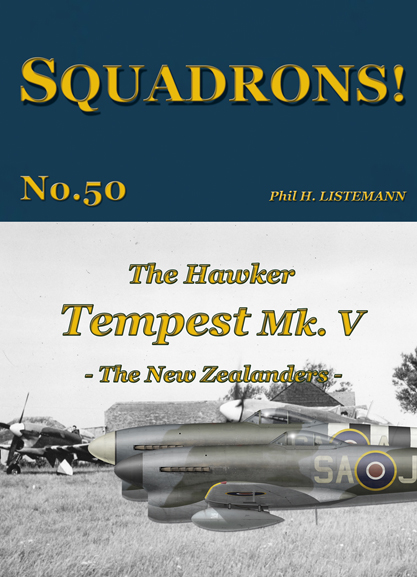
SQUADRONS! No.50: The Hawker Tempest Mk V – The New Zealanders

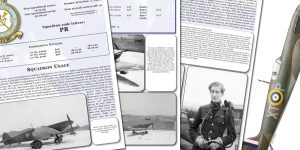
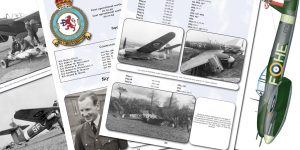
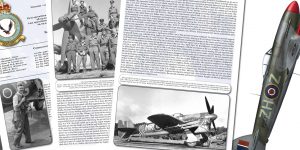
The Hawker Tempest was derived from the Hawker Typhoon. The new design was tested with various engines and eventually the Mk V was the first to enter service making its operational debut in January 1944 with the ADGB. The Tempest participated actively to the V-1 hunt during the summer of 1944, then the Tempest was sent to the Continent to join the 2TAF.
During the war eight fighter squadrons became operational on Tempest including 486 (NZ) Squadron, the first to convert but also the only non-British unit to fly it. The book covers the operational usage of this squadron. Close to 50 photos illustrate the book alongside eleven colour profiles and one colour plate.

REVISED JULY 2024
Available as a paperpack version with ISBN 979-1096490-84-4

**********************

HOW TO ORDER:

Send your mailing address  with your phone number in using ‘contact’ button and we will respond with a Paypal request with the following amount:

EU, UK and USA: 14.50 Euros postage included

Rest of the World: 16.50 Euros postage included

                                                      *******************************

PDF version is available as 979-1096490-85-1
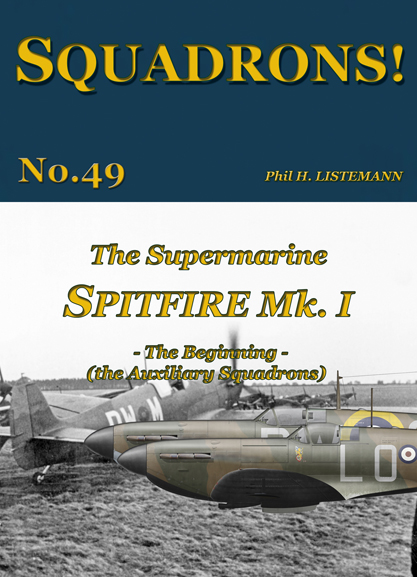
SQUADRONS! No.49: The Supermarine Spitfire Mk I – The beginning, the Auxiliary squadrons

The Spitfire was designed as a short-range interceptor which first flew on 5 March 1936 and was soon ordered in large quantities.The first production Spitfire came off the assembly line in mid-1938 and by the outbreak of war over 300 have been delivered to the RAF and ten squadrons already operational. During the Phoney War, the Spitfire was not deployed on the Continent and remained based on its British stations to defend the country while other squadrons were converted. It is in this role the Spitfire claimed its first victories over the Luftwaffe. When the military situation obliged the British to evacuate the continental Europe via Dunkirk, the Spitfire squadrons were called to cover the withdrawal, a period during which the type performed.
This chapter covers the operational usage of the Auxiliary squadrons (602, 603, 603, 609, 610, 611 and 616) between 1 September 1939 and 30 June 1940. Over 40 photographs and 8 colour plates illustrate the book.

(see SQUADRONS 62 for the Regular squadrons)

updated November 2023

Profiles:

K9962/LO-A – 602 Sqn (S/L AD Furquhar)

N3105/XT-P – 603 Sqn

L1068/PR-B – 609 Sqn

L1000/DW-M – 610 Sqn

R6595/DW-O – 610 Sqn

K9999/FY-D – 611 Sqn

L1055/QJ-U – 616 Sqn

Available as a paperpack version with ISBN 979-1096490-82-0

**********************

HOW TO ORDER:

Send your mailing address  with your phone number in using ‘contact’ button and we will respond with a Paypal request with the following amount:

EU, UK and USA: 13.50 Euros postage included

Rest of the World: 16.00 Euros postage included

                                                    ***********************************

PDF version is available as 979-1096490-83-7

new PDF uploaded November 2023

SQUADRONS! No.48: The Supermarine Spitfire Mk XIV – The British squadrons

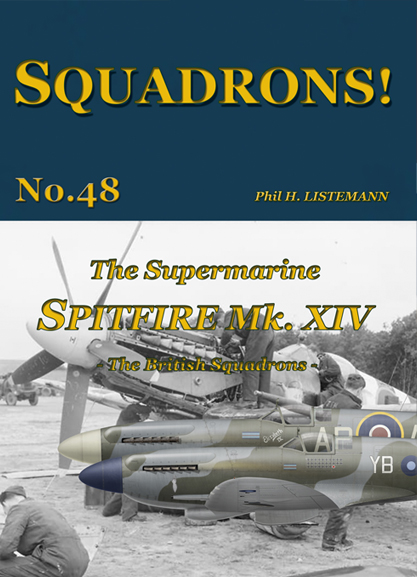
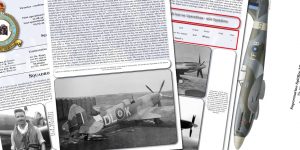
The Spitfire XIV was the logical development of the Spitfire Mk XII (see SQUADRONS! 5). The Mk.XIV differed from the Mk.XII in that the longer, two-stage supercharged Griffon 65 was mounted further forward. A new five-bladed Rotol propeller was used and was the most obvious visual difference compared to earlier marks. The first batch of aircraft to fly with the Griffon 60 series engines were six converted Mk.VIIIs . The first one of these was flown on 20 January 1943, with production ordered following a series of trials. The first aircraft left the production line in October 1943 following the amendment of existing Spitfire contracts. The XIV was initially seen as an interim design pending the Spitfire Mk.XVIII’s availability. Delays with the XVIII meant the XIV became one of the major Spitfire fighter variants and a valuable asset for the RAF during the final year of the war. The XIV was built as a fighter, but was also developed for fighter-reconnaissance (FR) to replace the effective, but ageing, Mustang in the Tac/R role. During the war only a limited number of squadrons were equipped with the type and among them, Nos. 41, 91, 130, 610 Sqns. This book covers the operational usage of the Spitfire XIV by these four fighter squadrons, as well the RAF tactical reconnaissance units (Nos. 2 and 268) which became operational before the end of the war in Europe. A short chapter covers also the arrival of the Spitfire XIV in the Far East. This book is illustrated with about 75 photos and ten colour profiles.

Profiles:

NH745/EB-V (S/L D.I. Benham)

MV260/EB-P (F/L A.O. Gaze – Australia)

NH654/DL-F (Lt H. de Bordas – France)

RB188/DL-K 

RM738/AP-A (S/L P.V.K. Tripe – Canada)

RB159/DW-D (S/L R.A. Newberry)

MV257/JEJ (G/C JE. Johnson)

TZ136/XC-P (S/L J.F. Roberts)

RN133/FF-B (S/L K.L. Charney)

RN135/YB-A (S/L J.H. Lacey)

Paperback version is available with ISBN 979-1096490-80-6

**********************

HOW TO ORDER:

Send your mailing address  with your phone number in using ‘contact’ button and we will respond with a Paypal request with the following amount:

EU, UK and USA: 18.50 Euros postage included 

Rest of the World: 20.50 Euros postage included

PDF version is available as 979-1096490-81-3

(new PDF uploaded August 2023)

SQUADRONS! No.47: The Westland Whirlwind

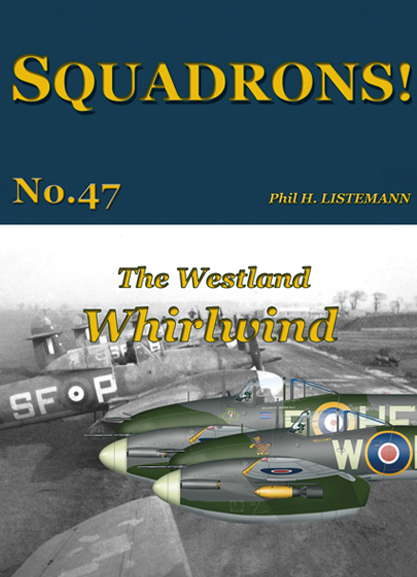
The Westland Whirlwind belongs to that category of aircraft which entered production but failed to live up to their designers’ expectations. Its unreliable engines can be seen as a major reason for this but it only serves to hide other serious problems. Indeed, even with better engines the results would probably have been the same, as the concept of a twin-engined fighter aircraft capable of meeting single-engined fighters escorting bombers formations on an equal footing was fallacious, as combat in WW2 was soon to prove. Only two squadrons flew the Whirlwind, Nos. 137 and 263 Squadrons.
This book is a deeply revised edition of Allied Wings No. 4 published in 2013, with the text largely enhanced and new photographs added. In all 60 photos and 12 colour profiles.

available as a paperback version with ISBN 979-1096490-78-3


*******************

HOW TO ORDER:

Send your mailing address and your phone number in using ‘contact’ button and we will respond with a Paypal request with the following amount:

EU, UK and USA: 16.50 Euros postage included

Rest of the World: 18.50 Euros postage included

PDF version is available as ISBN 979-1096490-79-0

(new PDF uplaoded August 2023)

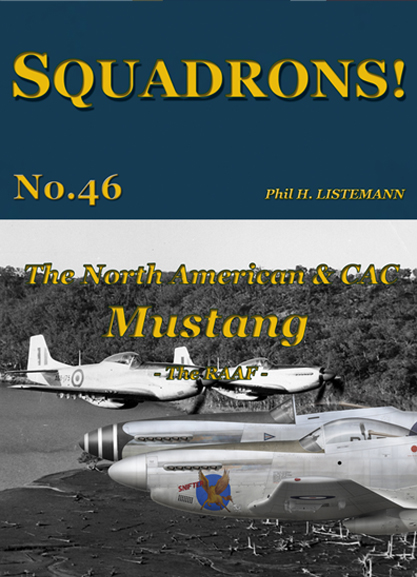
SQUADRONS! No.46: The North American & CAC Mustang – The RAAF

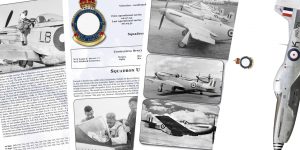
The North American P-51 is among the most famous fighters of WW2, and the P-51D probably the model the best known. In April 1944, the Australian Government selected the North American P-51 Mustang as the fighter type to be built in Australia to replace the Curtiss Kittyhawk to be built by the Commonwealth Aircraft Corporation (CAC). If the first Australian-built Mustang flew in April 1945 and the first deliveries began in June it had become evident the number of airframes produced during 1945 would not be adequate to replace all of the Kittyhawks. It was therefore decided to import batches of P-51Ds and P-51Ks from the US and the first squadrons were converted during the summer 1945 but did not become operational before VJ-Day.
The Mustang became the main fighter-bomber type of the RAAF in the post-war period and if the Mustang missed the end of WW2, it would participate to the first stages of the Korean War with 77 Squadron in 1950. This book relates the full RAAF usage of the Mustang which lasted in 1960. Illustrated with 50 photos and 7 colour profiles.

Profiles

A68-565/LB-V: 84 SQn RAAF (S/L J.A. Cox’s aircraft)

A68-527/LB-T: 84 Sqn RAAF

A68-724/K: 77 Sqn RAAF (S/L R.T. Susans’ aircraft)

A68-769: 82 Sqn RAAF (S/L F.R. Schaaf’s aircraft)

A68-803/BAE: 81 Wing RAAF (G/C B.A. Eaton’s aircraft)

A68-809: 77 Sqn RAAF (W/C L.T. Spence’s aircraft)

A68-141:  24 Sqn RAAF

Available as a paperback version with ISBN 979-1096490-76-9

*******************

HOW TO ORDER:

Send your mailing address and your phone number in using ‘contact’ button and we will respond with a Paypal request with the following amount:

EU, UK and USA: 16.50 Euros postage included

Rest of the World: 18.50 Euros postage included

PDF version is available as 979-1096490-77-6

(New PDF uploaded September 2023)

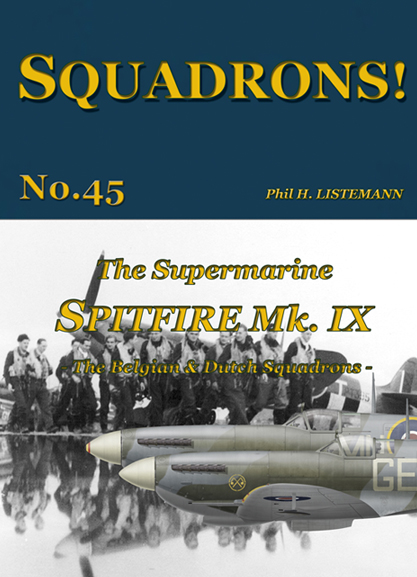
SQUADRONS! No.45: The Supermarine Spitfire Mk IX – The Belgian and Dutch squadrons

The Spitfire Mk.IX is one of the best known versions of the Spitfire. However, it should never really have existed. Its creation can be attributed to the appearance of the Focke-Wulf Fw190 over western Europe at the end of 1941. Royal Air Force pilots were quick to state the Spitfire Mk.V, the frontline RAF fighter at the time in Great Britain, was outclassed in many aspects by the new German fighter. The RAF, therefore, had to urgently find a solution to improve the Spitfire and with a new Merlin engine, the Spitfire Mk IX was born. The Mk.IX was produced for almost three years and would become one of the main fighters and fighter-bombers of the RAF in Europe in 1944 and 1945. In total, during the Second World War more than 100 fighter units were totally or partially equipped with the Spitfire, included the two Belgian fighter squadrons of the RAF, Nos. 349 and 350 and the only Dutch fighter squadron, No. 322. These three squadrons are here covered in 36 pages, close to 40 photos and six colour profiles.

Profiles:

MK365/3W-B – 322 Sqn

MJ360/3W-K – 322 Sqn

MJ748/GE-A – 349 Sqn

ML365/GE-I – 349 Sqn (S/L du Monceau)

PT891/GE-E – 349 Sqn

ML137/MN-Z – 350 Sqn


Available as a paper version with ISBN 979-1096490-74-5

**********************

HOW TO ORDER:

Send your mailing address  with your phone number in using ‘contact’ button and we will respond with a Paypal request with the following amount:

EU, UK and USA: 13.50 Euros postage included

Rest of the World: 16.00 Euros postage included

Multiple purchases with combined postage possible.

********************

PDF is available as 979-1096490-75-2.


(new PDF uploaded September 2023)


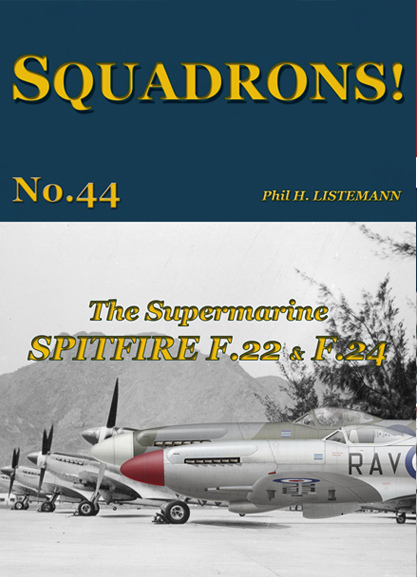
SQUADRONS! No.44: The Supermarine Spifire F.22 & F.24

Belonging to the ‘third generation’ of Spitfires, alongside the F.21 and the F.24, the Spitfire F.22 was developed almost in parallel to the F.21 and was identical to the 21 in all respects besides the cut-down rear fuselage (see SQUADRONS! No. 7 – The Spitfire F.21). Arriving too late to see any action during the war, the F.22 became eventually the backbone of the Auxiliary Air Force re-formed just after the war while the Spitfire F.24, the last mark of the Spitfire played however its role in this unstable post-war era even if it hasn’t been engaged in combat. Its presence in the British colony of Hong Kong, while the Communits China had been proclaimed, was far to be only symbolic. Illustrated with over 50 photos and 13 colour profiles.

Profiles:

PK622/V, No. 73 Squadron

PK497/RAD-V, No. 504 Squadron

PK633/RAG-Z, No. 600 Squadron

PK433/Q, No. 603 Squadron

PK337/RAO-A, No. 608 Squadron

PK650/FY-J, No. 611 Squadron

PK550/RAV-M, No. 615 Squadron

SR60, No. 1 Squadron, SRAF

VN311/W2-C, No. 80 Squadron

VN317/W2-P, No. 80 Squadron

VN489/W2-N, No. 80 Squadron

VN318/W2-E, No. 80 SquadronVN496/TN, W/C W.A. Nel

Available as a paperpack version with ISBN 979-1096490-72-1

**********************

HOW TO ORDER:

Send your mailing address  with your phone number in using ‘contact’ button and we will respond with a Paypal request with the following amount:

EU, UK and USA: 14.00 Euros postage included

Rest of the World: 16.50 Euros postage included

Multiple purchases with combined postage possible.

********************

 digital format pdf is available as 979-1094690-73-8

New pdf uploaded November 2023


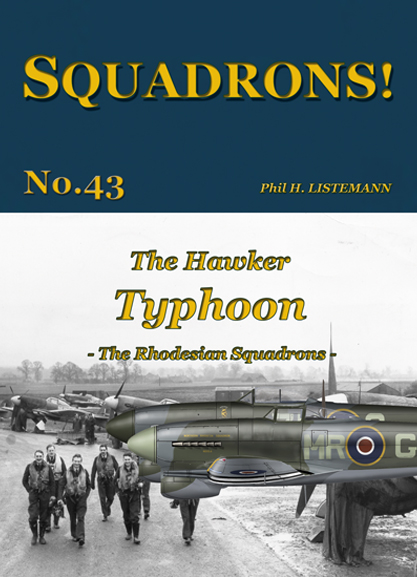
SQUADRONS! No.43: The Hawker Typhoon – The Rhodesian squadrons

The Hawker Typhoon was designed to Air Ministry specification F.18/37 which sought to take advantage of the new generation of 2000hp engines and satisfy the latest requirements in armament. This major step up demanded a larger and more advanced airframe than that of the company’s then current Hurricane and by March 1938 work had commenced on the first two prototypes; one with the Napier Sabre, soon called ‘Typhoon’ and the other with a Rolls-Royce Vulture, later to be named the ‘Tornado’; this latter machine was the first to fly, on 6 October 1939. The Vulture did not give too many problems in the Hawker fighter but by the end of 1940 it was experiencing serious trouble with its installation in the Avro Manchester bomber, and as a result the project was abandoned. With the third engine (Bristol Centaurus) of the new generation still some way off, the Air Ministry had little option but to concentrate on the Typhoon, which had made its first flight on 24 February 1940. The new aircraft encountered teething problems and was also delayed by production priorities for other Hawker types during the Battle of Britain. During its early operational life the Typhoon had to overcome problems that threatened to end its service, but these were eventually remedied so that, by the last quarter of 1943, the Typhoon had become a reliable aircraft. Improvements included the introduction of the new single piece ‘blown’ hood, a four-bladed propeller and an enlarged tailplane, but there was no change in designation. When production ceased in November 1945, 3317 Typhoons had been built.At first pure fighters were produced, but, by the spring of 1943, only the fighter-bomber version was coming off the production line and by the end of the year all the Typhoon squadrons were undertaking some form of ground attack role. On the eve of D-Day the Typhoon had become the backbone of the 2TAF fighter-bomber force with no less than eighteen squadrons active. This book narrates the operational usage of two squadrons, Nos. 245 and 266, which had both connections with Rhodesia. Illustrated with 39 photos and 10 colour plates.

Profiles:

245 Sqn: DN492/MR-G 

245 Sqn: DN248/MR-? (S/L JR Collins)

245 Sqn: MP197/MR-U (S/L A Zweigbergk)

266 Sqn: R7695/ZH-Z

266 Sqn: JP846/ZH-G (S/L PW Lefevre)

266 Sqn: MN133/ZH-G (S/L JWE Holmes)

266 Sqn: RB478/ZH-Q (S/L REG Sheward)

266 Sqn: PD521/ZH-Z 

121 Wing: MN666/C-G (W/C CL Green)

(plus a plate on the Typhoon identfication markings)


Available as a paperpack version with ISBN 979-1096490-70-7

**********************

HOW TO ORDER:

Send your mailing address  with your phone number in using ‘contact’ button and we will respond with a Paypal request with the following amount:

EU, UK and USA: 13.00 Euros postage included

Rest of the World: 15.50 Euros postage included

Multiple purchases with combined postage possible.

********************

Pdf format is available as 979-1096490-71-4

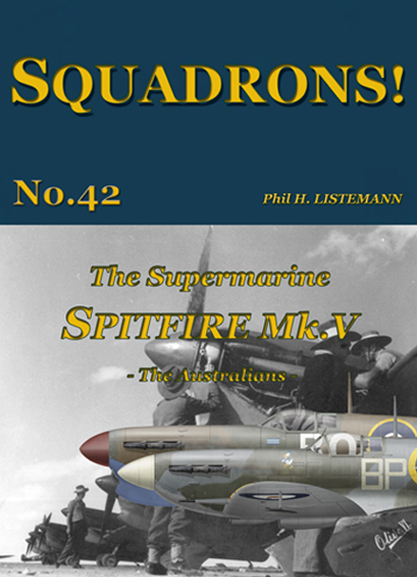
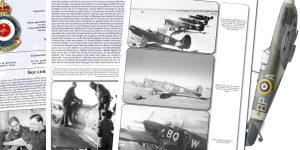
SQUADRONS! No.42: The Supermarine Mk V – The Australians

Paradoxically, the Mk.V, which ended up being the most numerous variant of the famous fighter built, was not even an intended development of the design. Indeed, it was only considered because of the abandonment of the Spitfire Mk.III. As the Luftwaffe was continually improving its formidable Messerschmitt Bf 109, the latest version of which, the Bf 109F, clearly outclassed the Spitfire Mk.II, the British had no other option but to rapidly find a successor to the latter. At this time, at the end of 1940, the British did not know what the Germans’ were planning and expected them to carry on undertaking daylight raids upon the return of nicer weather. The RAF, therefore, wanted to be ready to counter the new German fighter developments. A solution was soon found by mounting a Merlin 45 (former Merlin III), a simplified version of the Merlin XX, on a slightly strengthened Spitfire Mk.I or Mk.II airframe. Several Spitfires were thus modified, with either a Merlin 45 or Merlin 46, during the first weeks of 1941. The resulting feedback was good and the Air Ministry requested that Supermarine modify, as early as possible, Spitfires already on the assembly lines so they could be put into service as rapidly as possible. This is how the Spitfire Mk.V came to be. In 1941, the Spitfire Mk V progressively became the backbone of the Fighter Command and among the squadrons that switched onto the Spitfire Mk V, there are only the three Australian squadrons, Nos. 452, 453 and 457 while in the Middle East, the Australians operated also the Spitfire Mk V with No. 451. Their actions are fully described here in 64 pages, illustrated with 75 photos and seven colour profiles. The usage of the Spitfire V in Australia is not included in this book.

PAPERPACK VERSION – SOLD OUT

Profiles:

EE797/BQ-Y – 451 Sqn

AB842/UD-X – 452 Sqn

AB198/UD-R – 452 Sqn

EP605/FU-Z – 453 Sqn

BL384/BP-N – 457 Sqn (F/L JAA Gibson)

BM143/BP-A – 457 Sqn (S/L PM Brothers)

BL636/BP-P – 457 Sqn 


available as an ebook with ISBN 979-1096490-69-1


New PDF uploaded December 2023


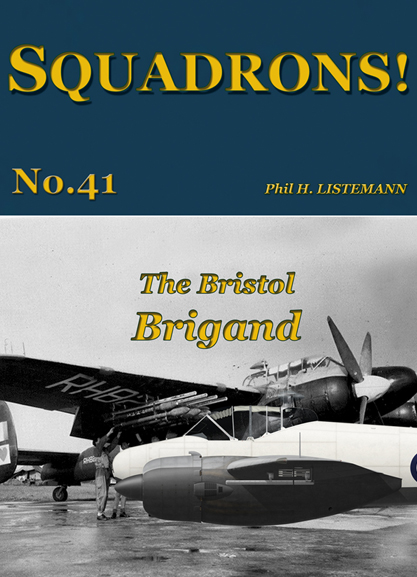
SQUADRONS! No.41: The Bristol Brigand

The Bristol Brigand was developed at the end of WW2 as a replacement for the Bristol Beaufighter. Initially developed as a torpedo-fighter, the design was modified after the war in the aim to use the Brigand as a light bomber. The Brigand was later deployed overseas and served in the Middle East and the Far East, participating to the Malayan Emergency in the early fifties with Nos. 45 and 84 Squadrons, while in UK it was used in its training versions. This book is illustrated with 40 photos and 5 colour profiles. The Bristol Buckingham and Buckmaster are also covered in this book.

REVISED OCTOBER 2022

Profiles:

VS816/A – 8 Sqn

RH829/OB-M – 45 Sqn

RH776/K – 84 Sqn

RH811/G – 84 Sqn

RH823/P – 84 Sqn

Available as a paperpack version with ISBN 979-1096490-66-0

**********************

HOW TO ORDER:

Send your mailing address  with your phone number in using ‘contact’ button and we will respond with a Paypal request with the following amount:

EU, UK and USA: 14.00 Euros postage included

Rest of the World: 16.50 Euros postage included

Multiple purchases with combined postage possible.

********************

PDF available as 979-1096490-67-7

(new PDF uploaded August 2023)