Archives

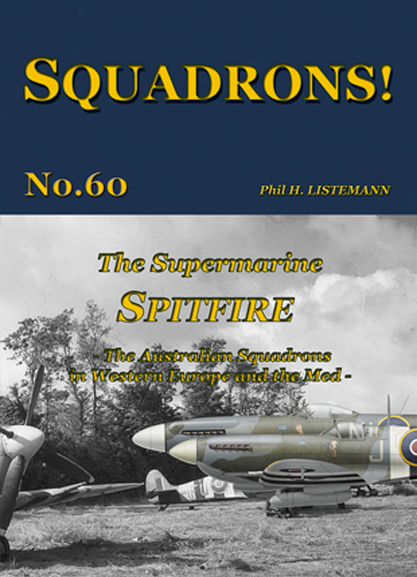
SQUADRONS! No.60: The Supermarine Spitfire – The Australian squadrons in Western Europe and the Med

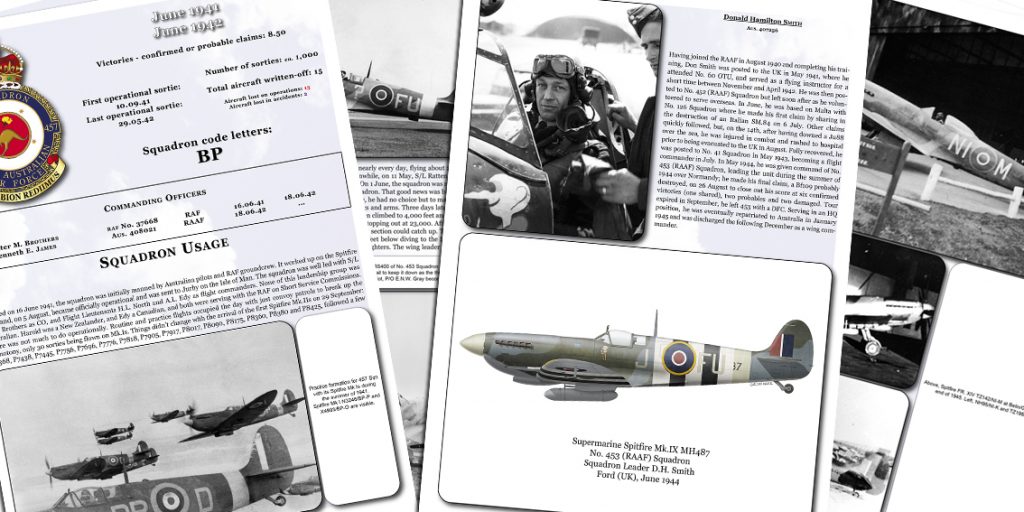
Having begun to expand in the 1930s, the RAAF still only had twelve permanent squadrons when war was declared. However, 10 Squadron was already in the UK to pick up its new Short Sunderlands, 3 Squadron left for the Middle East several months later and other units soon departed for the Far East. That was not enough to face the challenges imposed by the air war to come and a massive expansion was initiated. Within two years, and counting only the units earmarked to be placed under RAF authority, no less than seventeen squadrons were formed. However only four were dedicated to the day fighter role — 450 in the Middle East, 452 and 457 in the UK, and 453 in the Far East. From the start, 452 attracted attention from the media thanks of its considerable successes in 1941-1942, the Australian fighter pilots making the most claims among the nations of the Empire. This initial assignment changed dramatically with the Japanese invasion of South East Asia, however, and the disaster that followed, ending with the fall of Singapore and the threat of an invasion of Australia in the spring of 1942. While the Brewster Buffalo equipped 453 Squadron was wiped out at Singapore (see SQUADRONS! 33), 452 and 457 were urgently recalled to Australia, leaving the RAAF with no fighter presence in UK, a situation that was not acceptable from an Australian political point of view. That led to the re-formation of 453 Squadron in the UK while 452 and 457 were embarking for Australia. The unit never replaced 452 in the media, partly because it had less success and, therefore, the Australian fighter pilots in Europe rarely made headlines from then on. Furthermore, and as far as a day fighter force was concerned, the RAAF was hampered by its involvement in the South West Pacific and couldn’t increase its fighter presence in the UK despite the arrival of 451 Squadron in 1944 following its switch from the tactical reconnaissance role the previous year. Further RAAF fighter squadrons may have helped attract attention, but that never happened. Consequently, the RAAF has been under-represented in the fighter role unlike, for example, the Canadians who deployed a dozen fighter squadrons in Western Europe, and, like the Australians, participated actively in the liberation of Europe, receiving far more attention in the process. Only four Australian fighter squadrons eventually used the Spitfire while serving in Western Europe or on the Mediterranean theatres, Nos. 452, 457, 453 and 451, from the first to the last user. In all, 127 victories were claims (confirmed or probable) by these four squadrons in over 13,000 operational sorties, losing in the same time 100 aircraft and 70 pilots to all causes.

ISBN: 978-2-494471-02-3
************************

HOW TO ORDER:

Send your mailing address  with your phone number in using ‘contact’ button and we will respond with a Paypal request with the following amount:

EU, UK and USA: 20.00 Euros postage included

Rest of the World: 22.00 Euros postage included

Multiple purchases with combined postage possible.

********************************

PDF version is also available as 978-2-494471-03-0

(see below)
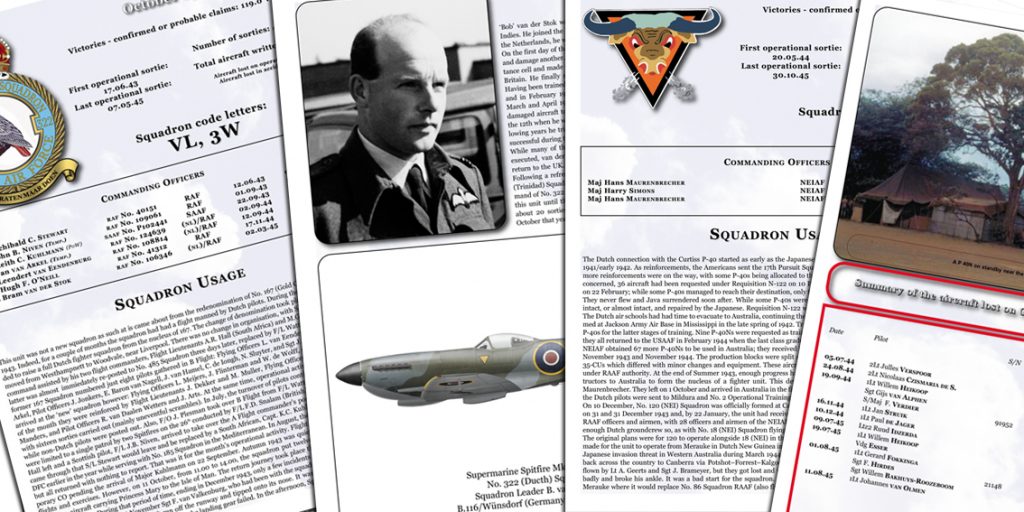
SQUADRONS! No.59: The Dutch Fighter squadrons

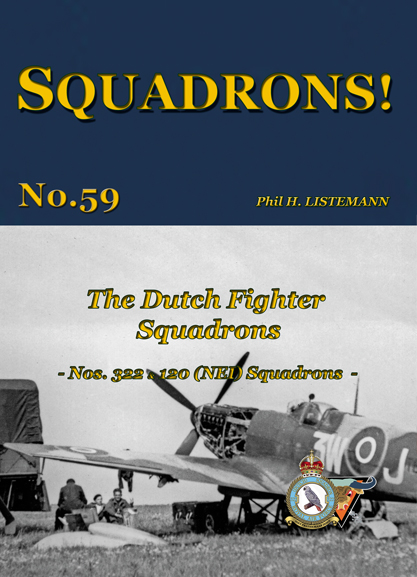
During WW2, the Netherlands and the Netherlands East Indies (NEI) were both occupied after their armed forced had been overrun. However, many Dutchmen decided to continue the struggle and eventually found asylum either in Great Britain either in Australia. Despite the meagre forces available, the Dutch managed to form two fighter squadrons, one in UK, No. 322 placed under RAF command, and one in Australia, No. 120 placed under RAAF command. This book narrates their respective operational commitment between 1943-1945 in 40 pages illustrated with about 40 images and 6 colour profiles.

ISBN: 978-2-494471-00-9

************************

HOW TO ORDER:

Send your mailing address  with your phone number in using ‘contact’ button and we will respond with a Paypal request with the following amount:

EU, UK and USA: 13.50 Euros postage included

Rest of the World: 15.50 Euros postage included

Multiple purchases with combined postage possible.

********************************

PDF version is also available as 978-2-494471-01-6

(see below)

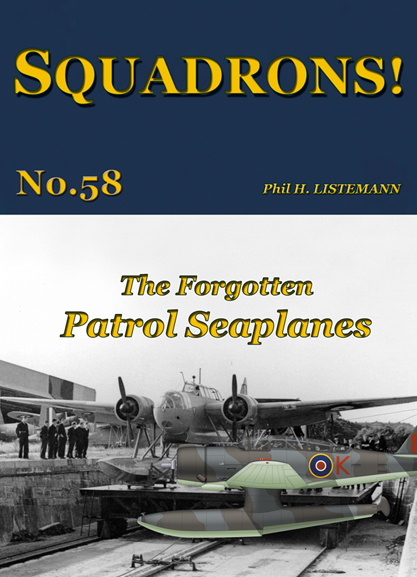
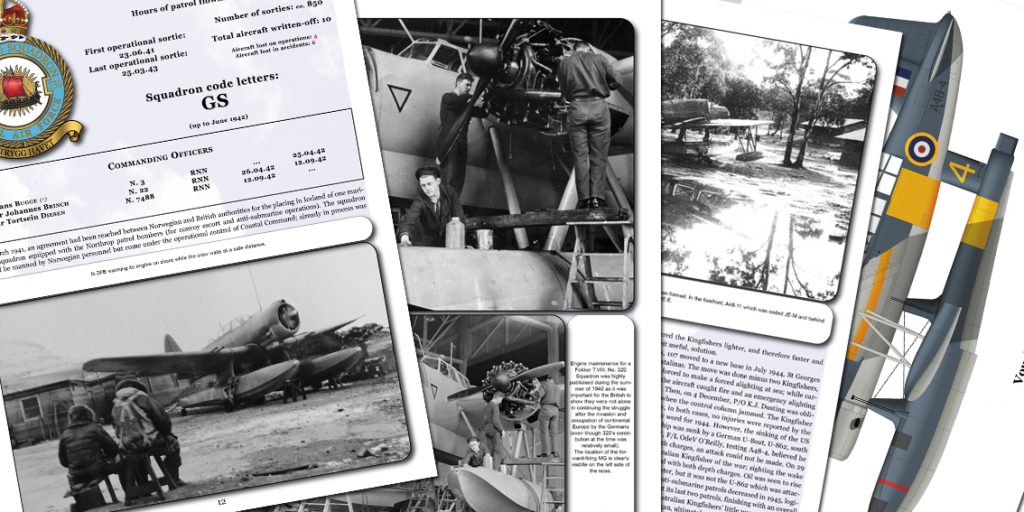
SQUADRONS! No.58: The Forgotten Patrol Seaplanes

The fortunes of war gave the opportunity for some aircraft types to play a role or fly in markings other than originally intended. With the invasion of many European countries in the first months of the war, only the British Empire remained in the fight with bases relatively safe to operate from. Many defeated airmen, often with their aircraft, found asylum at these bases. Among the aircraft which fled their original countries were patrol seaplanes. In some cases, the numbers of certain aircraft, or the fact they were simply in the right place at the right time, were enough to for the RAF to consider their use. This was certainly true for the Dutch Fokker T.VIIIs, Yugoslavian Dornier 22s and the Rogožarski SIM-XIV. Alternatively, it was often simply an order of aircraft not delivered before the destination country fell to the enemy. That was the case for the Norwegians’ Northrop N-3PBs and the Netherlands’ Vought OS2U Kingfishers. Those types entered RAF and RAAF service respectively but, because of the small quantities involved, they did not see widespread use; that doesn’t mean they were useless though. 35 photos.

ISBN: 979-1096490-99-8

************************

HOW TO ORDER:

Send your mailing address  with your phone number in using ‘contact’ button and we will respond with a Paypal request with the following amount:

EU, UK and USA: 13.50 Euros postage included

Rest of the World: 15.50 Euros postage included

Multiple purchases with combined postage possible.

********************

PDF version is also available as 978-2-494471-05-4

(see below)

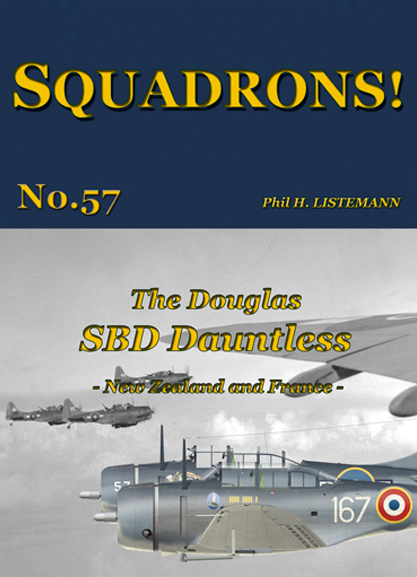
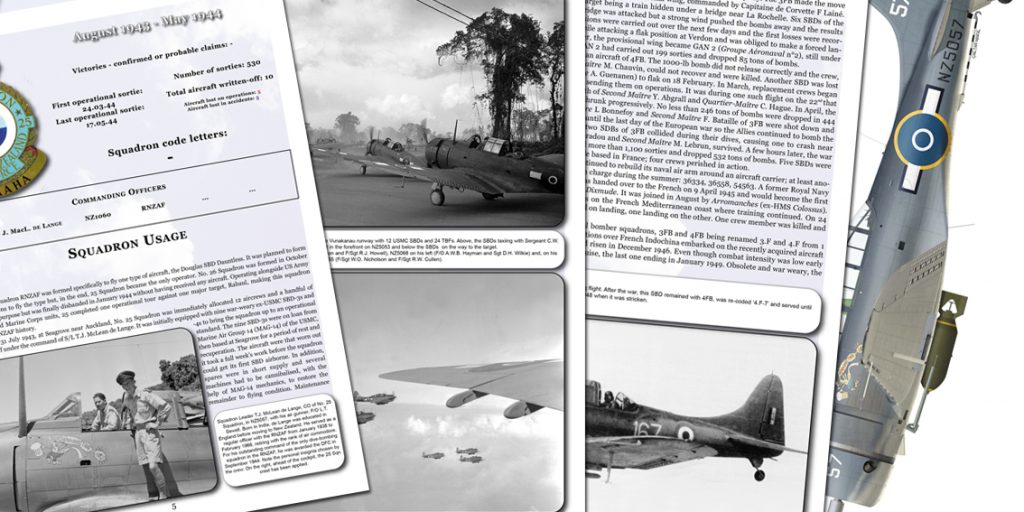
SQUADRONS! No.57: The Douglas SBD Dauntless – New Zealand and France

Conceived in 1939 from the BT-1, the Douglas SBD Dauntless was almost obsolescent by the time the USA went into war in December 1941. However, in the absence of a suitable replacement, it became the backbone of the Pacific air war and rendered excellent service as a bomber, dive bomber, scout and reconnaissance aircraft until 1945. Even if close to 6,000 aircraft were produced during the war until the summer of 1944, very few were eventually supplied to the Allies. A single RNZAF squadron, No. 25, completed a tour in the Solomons in 1944, while the French Navy used the SBD against German strongholds on the French Atlantic coast in 1944-1945. Illustrated with about 50 photos.

ISBN: 979-1096490-98-1

************************

HOW TO ORDER:

Send your mailing address  with your phone number in using ‘contact’ button and we will respond with a Paypal request with the following amount:

EU, UK and USA: 13.50 Euros postage included

Rest of the World: 15.50 Euros postage included

Multiple purchases with combined postage possible.

******************

PDF version is also available as 978-2-494471-04-7

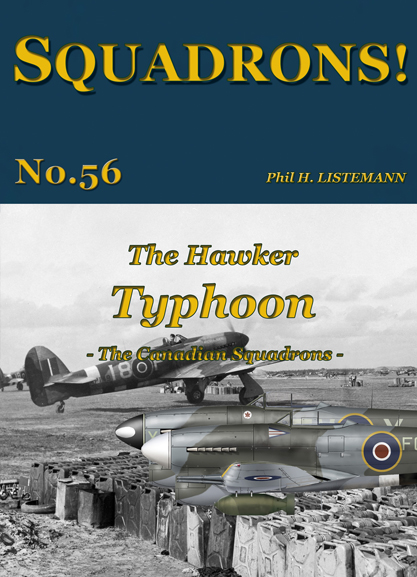
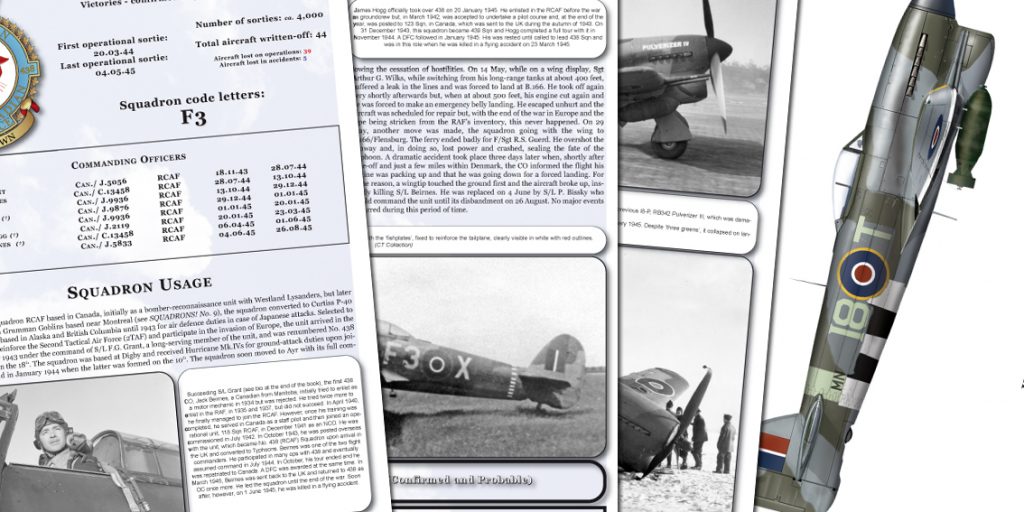
SQUADRONS! No.56: The Hawker Typhoon – The Canadian squadrons

The Hawker Typhoon was designed to Air Ministry specification F.18/37 which sought to take advantage of the new generation of 2000hp engines and satisfy the latest requirements in armament. This major step up demanded a larger and more advanced airframe than that of the company’s then current Hurricane and by March 1938 work had commenced on the first two prototypes; one with the Napier Sabre, soon called ‘Typhoon’ and the other with a Rolls-Royce Vulture, later to be named the ‘Tornado’; this latter machine was the first to fly, on 6 October 1939. The Vulture did not give too many problems in the Hawker fighter but by the end of 1940 it was experiencing serious trouble with its installation in the Avro Manchester bomber, and as a result the project was abandoned. With the third engine (Bristol Centaurus) of the new generation still some way off, the Air Ministry had little option but to concentrate on the Typhoon, which had made its first flight on 24 February 1940. The new aircraft encountered teething problems and was also delayed by production priorities for other Hawker types during the Battle of Britain. During its early operational life the Typhoon had to overcome problems that threatened to end its service, but these were eventually remedied so that, by the last quarter of 1943, the Typhoon had become a reliable aircraft. Improvements included the introduction of the new single piece ‘blown’ hood, a four-bladed propeller and an enlarged tailplane, but there was no change in designation. When production ceased in November 1945, 3317 Typhoons had been built. At first pure fighters were produced, but, by the spring of 1943, only the fighter-bomber version was coming off the production line and by the end of the year all the Typhoon squadrons were undertaking some form of ground attack role. On the eve of D-Day the Typhoon had become the backbone of the 2TAF fighter-bomber force with no less than eighteen squadrons active. This book narrates the operational usage of the three RCAF squadrons, Nos. 438, 439 & 440. Illustrated with 48 photos and 9 colour plates.

Available as a paperpack version with ISBN 979-1096490-96-7

**********************

HOW TO ORDER:

Send your mailing address  with your phone number in using ‘contact’ button and we will respond with a Paypal request with the following amount:

EU, UK and USA: 14.50 Euros postage included

Rest of the World: 16.00 Euros postage included

Multiple purchases with combined postage possible.

********************

PDF version is also available as 9791096490-97-4

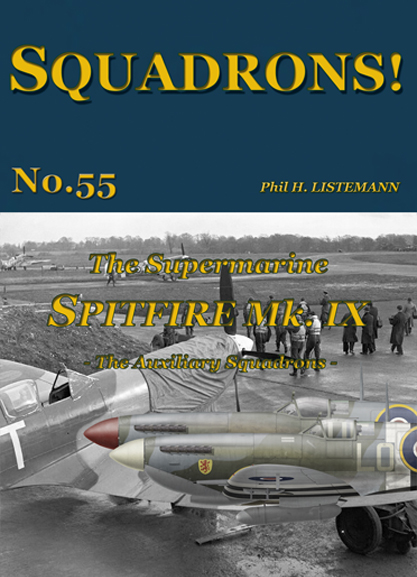
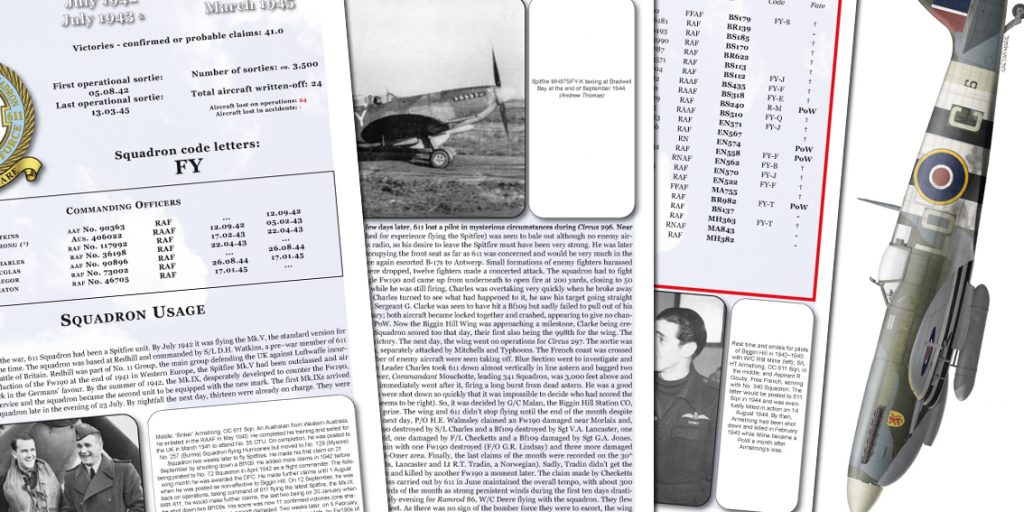
SQUADRONS! No.55: The Supermarine Spitfire Mk IX – The Auxiliary squadrons

The Spitfire Mk.IX is one of the best known versions of the Spitfire. However, it should never really have existed. Its creation can be attributed to the appearance of the Focke-Wulf Fw190 over western Europe at the end of 1941. Royal Air Force pilots were quick to state the Spitfire Mk.V, the frontline RAF fighter at the time in Great Britain, was outclassed in many aspects by the new German fighter. The RAF, therefore, had to urgently find a solution to improve the Spitfire and with a new Merlin engine, the Spitfire Mk IX was born. The Mk.IX was produced for almost three years and would become one of the main fighters and fighter-bombers of the RAF in Europe in 1944 and 1945. In total, during the Second World War more than 100 fighter units were totally or partially equipped with the Spitfire. Among them, there were four Auxiliary Air Force squadrons which flew the Mk IX with the Fighter Command or/and the 2 TAF (501, 504, 602 and 611) and a fifth in Italy (601). Illustrated with 45 photographs and 9 colour profiles.

Available as a paperpack version with ISBN 979-1096490-94-3

**********************

HOW TO ORDER:

Send your mailing address  with your phone number in using ‘contact’ button and we will respond with a Paypal request with the following amount:

EU, UK and USA: 14.50 Euros postage included

Rest of the World: 17.00 Euros postage included

***********************************

PDF version is available as 979-1096490-95-0

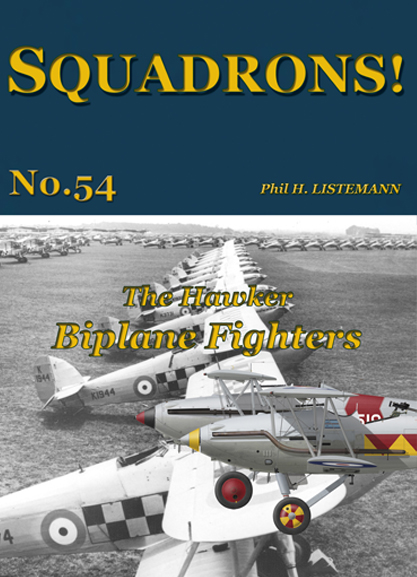
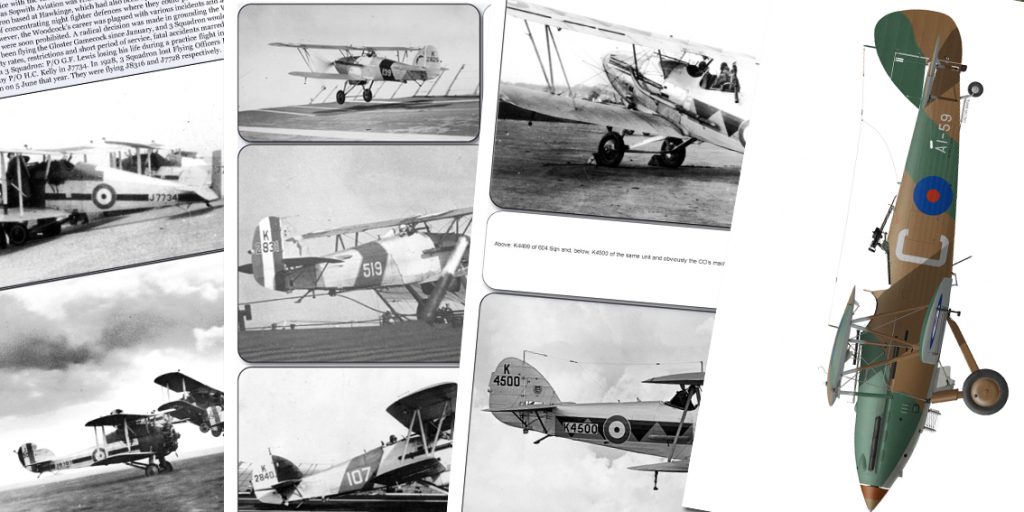
SQUADRONS! No.54: The Hawker biplane fighters

Hawker had its roots in the aftermath of the First World War, which resulted in the bankruptcy of the Sopwith Aviation Company. The new team began to work on new models and during the 20s and the 30s, the company produced a few fighter aircraft which saw operational service with the RAF. Until Hawker designed the famous Hurricane, a few biplane fighters were put into service in the RAF, the Woodcock, the Fury, the Nimrod and the Demon of which the last three were still in service when war broke out even if it was not necessary in the fighter role. Over 100 photos and 9 colour profiles illustrate the book, a book which covers also the usage of the Fury by the SAAF which fought again the Italians in East Africa in 1940-1941 and the Demon by the RAAF.

Available as a paperback version as 979-1096490-92-9

**********************

HOW TO ORDER:

Send your mailing address  with your phone number in using ‘contact’ button and we will respond with a Paypal request with the following amount:

EU, UK and USA: 18.00 Euros postage included

Rest of the World: 20.00 Euros postage included

  ***********************************

PDF version is available as 979-1096490-93-6

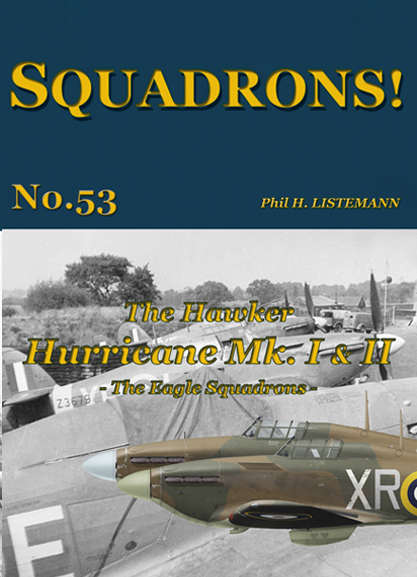
SQUADRONS! No.53: The Hawker Hurricane Mk I & Mk II – The Eagle Squadrons

The Hawker Hurricane was the first of the modern fighter types to begin re-equipping the RAF in the 1930s. As the RAF was undergoing a massive expansion in the mid-thirties, the Hurricane, which performed well during its trials, was soon ordered in large numbers. In June 1936, the first order was placed for 600 aircraft. In November 1938, just after the Munich Crisis, another order was placed for 1000. When war broke out almost 500 Hurricanes had been delivered to Fighter Command and that number had reached 2300 one year later. The Hurricane remained the backbone of the RAF’s fighter force at least until 1942 in Europe, 1943 in the Mediterranean and the Middle East, and 1944 in the Far East, when more modern types were introduced or became more plentiful. It remained in frontline inventory in the Middle and Far East until the very last days of the war. Indeed, while the Hurricane as a pure fighter was easily obsolete by that time, it proved to be a fine fighter-bomber. The Hurricane was involved in most of the first combats against the Luftwaffe over France and then over Britain. The basic model was continually improved and the Mk.II appeared in 1941. In 1940, American volunteers began to reach the UK to enlist in the RAF to fight against the Luftwaffe. Once trained they formed their own units, called the Eagle squadrons and in 1940-1941 three fighter squadrons were formed, Nos. 71, 121 and 133 equipped with Hurricanes…The Americans pilots would soon claim their first victories over the Luftwaffe. 30 photos, 5 profiles.

************************

HOW TO ORDER:

Send your mailing address  with your phone number in using ‘contact’ button and we will respond with a Paypal request with the following amount:

EU, UK and USA: 13.00 Euros postage included

Rest of the World: 14.50 Euros postage included

Multiple purchases with combined postage possible.

********************

PDF version is also available as 9791096490-91-2

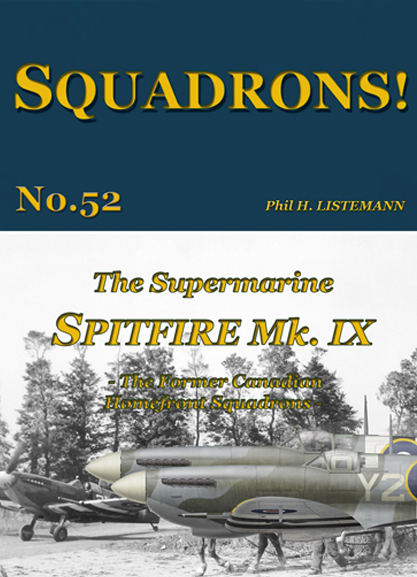
SQUADRONS! No.52: The Supermarine Spitfire Mk IX – The former Canadian Homefront squadrons

The Spitfire Mk.IX is one of the best known versions of the Spitfire. However, it should never really have existed. Its creation can be attributed to the appearance of the Focke-Wulf Fw190 over western Europe at the end of 1941. Royal Air Force pilots were quick to state the Spitfire Mk.V, the frontline RAF fighter at the time in Great Britain, was outclassed in many aspects by the new German fighter. The RAF, therefore, had to urgently find a solution to improve the Spitfire and with a new Merlin engine, the Spitfire Mk IX was born. The Mk.IX was produced for almost three years and would become one of the main fighters and fighter-bombers of the RAF in Europe in 1944 and 1945. In total, during the Second World War more than 100 fighter units were totally or partially equipped with the Spitfire. Ten 2TAF fighter squadrons of the RCAF flew the type. That includes three squadrons (441, 442 and 443) which were transferred in December 1943 from Canada to the UK to reinforce the RCAF Overseas. About 50 photographs, 10 colour profiles.

Available as a paperpack version with ISBN 979-1096490-88-2

**********************

HOW TO ORDER:

Send your mailing address  with your phone number in using ‘contact’ button and we will respond with a Paypal request with the following amount:

EU, UK and USA: 14.50 Euros postage included

Rest of the World: 17.00 Euros postage included

                                                             ***********************

PDF version is also available as 9791096490-89-9

REVISED APRIL 2024 (bios added)

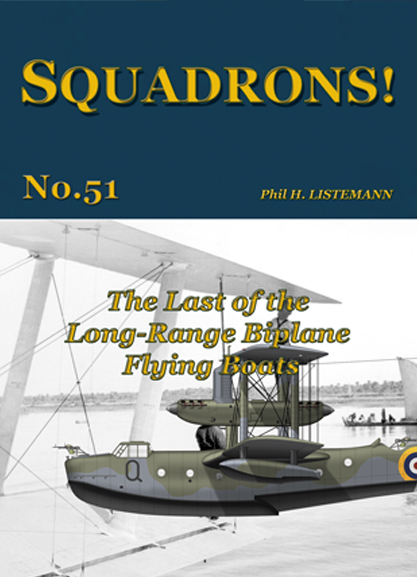
SQUADRONS! No.51: The Last of the Long-Range Biplane Flying Boats

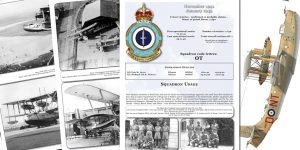
In the years following the end of WW1, the RAF produced a variety of specifications for long-range reconnaissance flying boats. During the thirties, some types were put into service, the Blackburn Iris, the Blackburn Perth and the Short Rangoon which never gave full satisfaction until the Short Singapore came up. The Short Singapore was built in significant numbers and was still in service when WW2 broke out. The Singapore remained in service until the end of 1941 with the RAF and the last ones were passed on to the RNZAF which used them up to the spring of 1943. This book covers the operational usage of these four biplane flying boats illustrated with 50 photos and 12 colour profiles.

Available as a paper version with ISBN 979-1096490-86-8

**********************

HOW TO ORDER:

Send your mailing address  with your phone number in using ‘contact’ button and we will respond with a Paypal request with the following amount:

EU, UK and USA: 13.50 Euros postage included

Rest of the World: 16.00 Euros postage included

                                                   ***********************************

PDF version is also available as 9791096490-85-1