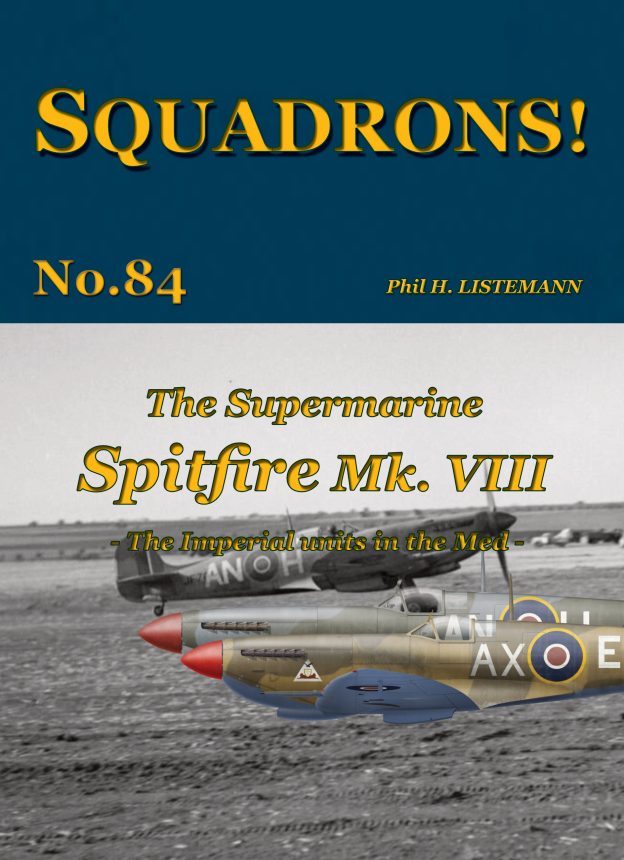
Designed before the Mk. IX, but following it into service because its radical design changes would have meant production delays when time was of the essence, the Spitfire Mk. Vlll was in fact a non-pressurised version of the Mk. VII designed for low altitude combat (see SQUADRONS! No. 6). At the outset it was the designated successor to the Mk. V, the replacement of which was planned from 1943 onwards but when it became available the Mk. IX had recently entered service with Fighter Command and appeared to have a bright future. Therefore, the RAF decided to retain the Mk. VIII for overseas theatres – the Mediterranean, Far East and the Pacific – where the replacement of the Spitfire Mk. V had become a necessity. It was in the Mediterranean that the Mk. VIII first entered service at the end of spring 1943. In the Med, and more precisely in Italy, the Spitfire Mk VIII was initially introduced in small number in various Spitfire units, at the time flying the Mk V variant but also some Mk IXs. Only five maybe six squadrons can be seen as having exclusively flown the Mk VIII and sometimes for a rather short time, the Mk IX having arrived in the region in large numbers from 1944 onwards. Of the five or six squadrons previously mentioned, three were not British, No 1 Squadron SAAF, No 417 (RCAF) Squadron and No 451 (RAAF) Squadron, of which only the Canadian squadron used the Mk VIII for a long time, almost until the end of the war.
+++++++++++++++++++
HOW TO ORDER:
Send your mailing address with your phone number in using ‘contact’ button and we will respond with a Paypal request with the following amount:
EU, UK and USA: 12.00 Euros postage included
Rest of the World: 13.50 Euros postage included
Multiple purchases with combined postage possible.
********************
PDF version is also available as 978-2-494471-57-3
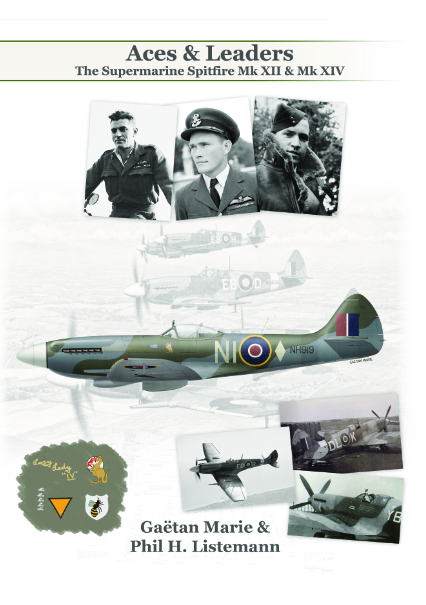
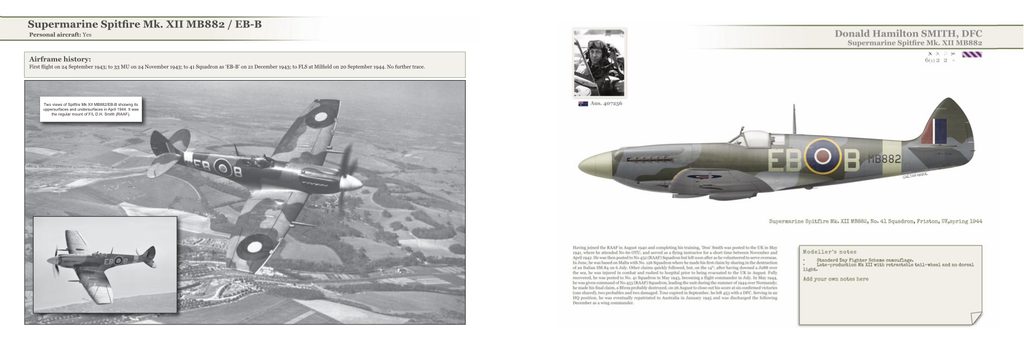
Combining meticulously-researched historical context with high-fidelity aircraft illustrations, Gaëtan Marie and Phil H. Listemann present a history of some of the most notorious aces and leaders to fly the Supermarine Spitfire Mk XII and Mk XIV in combat. The Spitfire Mk XII was the first production variant powered by the Rolls-Royce Griffon engine, giving it excellent low-altitude speed and climb performance for intercepting German fighters and raiders. The later Mk XIV combined a more powerful two-stage Griffon engine with improved aerodynamics, making it one of the fastest and most capable Spitfires of the war. It was especially important in combating V-1 flying bombs and opposing advanced German aircraft from 1944 onwards. Together, these variants marked the Spitfire’s evolution from a light Merlin-powered fighter into a heavier, faster and more powerful interceptor, while preserving the aircraft’s famous agility and handling qualities. In 40 aircraft profiles are included in this publication, offering inspiration to modelers.
85 pages, 40 profiles, 34 bios
A SQUADRONS! spin-off series, mainly focusing with modellers’ needs
ISBN 978-2494471-54-2
HOW TO ORDER:
Send your mailing address with your phone number in using ‘contact’ button and we will respond with a Paypal request with the following amount:
EU, UK and USA: 23.00 Euros postage included
Rest of the World: 25.00 Euros postage included
Multiple purchases with combined postage possible.
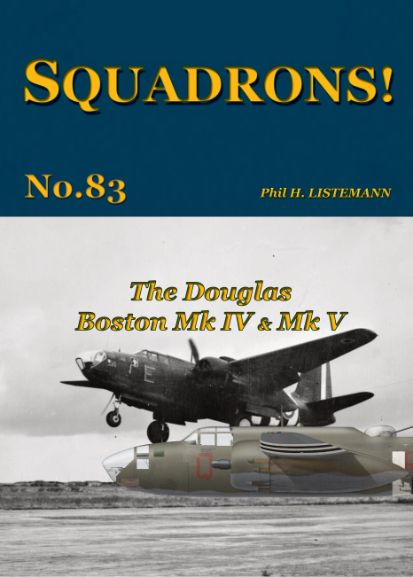
The Douglas Boston is one major aircraft of WW2. Designed as a light bomber, it proved to be very versatile and was used with success in various roles over all theatres of operations. As a light bomber, the RAF widely used the Mk III, but in 1944, the RAF began to put into service the improved versions, the Mk IV and Mk V, initially in Western Europe with the 2TAF shortly after D-Day (Nos 88 and 342 Squadrons) but soon after in Italy where the Mk IV and Mk V were used with great success in night intruder missions (Nos 13, 18, 55 and 114 Squadrons).
HOW TO ORDER:
Send your mailing address with your phone number in using ‘contact’ button and we will respond with a Paypal request with the following amount:
EU, UK and USA: 12.00 Euros postage included
Rest of the World: 13.50 Euros postage included
Multiple purchases with combined postage possible.
********************
PDF version is also available as 978-2-494471-53-5
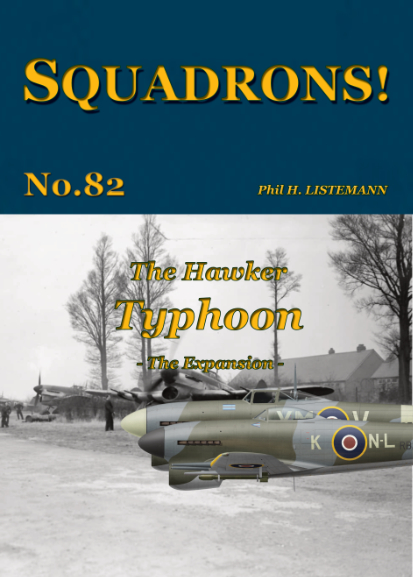
The Hawker Typhoon was designed to Air Ministry specification F.18/37 which sought to take advantage of the new generation of 2000hp engines and satisfy the latest requirements in armament. This major step up demanded a larger and more advanced airframe than that of the company’s then current Hurricane and by March 1938 work had commenced on the first two prototypes; one with the Napier Sabre, soon called ‘Typhoon’ and the other with a Rolls-Royce Vulture, later to be named the ‘Tornado’; this latter machine was the first to fly, on 6 October 1939. The Vulture did not give too many problems in the Hawker fighter but by the end of 1940 it was experiencing serious trouble with its installation in the Avro Manchester bomber, and as a result the project was abandoned. With the third engine (Bristol Centaurus) of the new generation still some way off, the Air Ministry had little option but to concentrate on the Typhoon, which had made its first flight on 24 February 1940. The new aircraft encountered teething problems and was also delayed by production priorities for other Hawker types during the Battle of Britain. During its early operational life the Typhoon had to overcome problems that threatened to end its service, but these were eventually remedied so that, by the last quarter of 1943, the Typhoon had become a reliable aircraft. Improvements included the introduction of the new single piece ‘blown’ hood, a four-bladed propeller and an enlarged tailplane, but there was no change in designation. When production ceased in November 1945, 3317 Typhoons had been built.At first pure fighters were produced, but, by the spring of 1943, only the fighter-bomber version was coming off the production line and by the end of the year all the Typhoon squadrons were undertaking some form of ground attack role. On the eve of D-Day the Typhoon had become the backbone of the 2TAF fighter-bomber force with no less than eighteen squadrons active. This book narrates the operational usage of six squadrons, Nos. 181, 182, 183, 195, 197 and 198 which were all formed during the second half of 1942, when the Typhoon fleet began to expand. Illustrated with about 100 photographs and 20 colour profiles and 17 bios of Typhoons leaders.
ISBN: 978-2494471-50-4
******************************
HOW TO ORDER:
Send your mailing address with your phone number in using ‘contact’ button and we will respond with a Paypal request with the following amount:
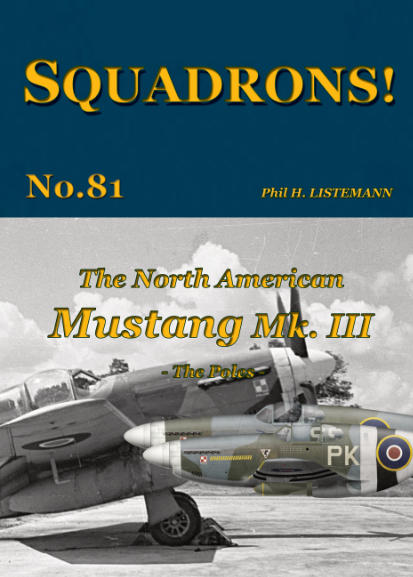
The North American Mustang is certainly one of the legendary fighters of the Second World War. The aircraft can be split into two ‘families’, the Allison-powered and Merlin-powered. The RAF Marks I and II belong to the first category, while all subsequent marks belong to the second. The change of engine made the aircraft perform far better at higher altitudes. The Merlin 61 (with the two-stage supercharger) provided significantly improved results above 15,000 feet and was without compare above 20,000 feet. All this without sacrificing range. This was a key point as, in 1942, the RAF was looking for a long-range escort fighter, a role the Spitfire, whatever the mark, could not fulfill with complete satisfaction from the British Isles. The British conducted an experimental programme with the new engine on various test-beds (known within the RAF as the Mustang X) while the Americans were doing the same thing on their side. The Americans first discovered the best way to pair the Merlin and the airframe and, after the first flight of the XP-51B on 30 November 1942, the future of the P-51B was guaranteed. The British ordered hundred of Mustang IIIs (denomination given to both P-51B and P-51C) and they served in Western Europe and in Italy. In western Europe, thirteen fighter squadrons became operational on Mustang III during the war, of which four were Polish units (Nos 306, 309, 315 and 316). This book develops the operational usage of the Polish squadrons up to September 1945. Thirteen short bios of Polish leaders and fourteen colour profiles (for paperback version only) illustrate this study. (see SQUADRON! 80 for the British squadrons).
ISBN: 978-2494471-48-1
******************************
HOW TO ORDER:
Send your mailing address with your phone number in using ‘contact’ button and we will respond with a Paypal request with the following amount:
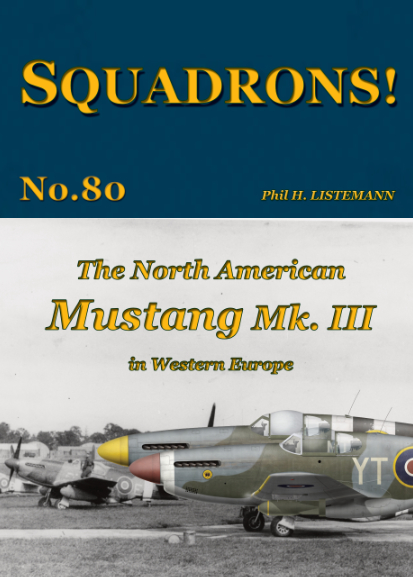
The North American Mustang is certainly one of the legendary fighters of the Second World War. The aircraft can be split into two ‘families’, the Allison-powered and Merlin-powered. The RAF Marks I and II belong to the first category, while all subsequent marks belong to the second. The change of engine made the aircraft perform far better at higher altitudes. The Merlin 61 (with the two-stage supercharger) provided significantly improved results above 15,000 feet and was without compare above 20,000 feet. All this without sacrificing range. This was a key point as, in 1942, the RAF was looking for a long-range escort fighter, a role the Spitfire, whatever the mark, could not fulfill with complete satisfaction from the British Isles. The British conducted an experimental programme with the new engine on various test-beds (known within the RAF as the Mustang X) while the Americans were doing the same thing on their side. The Americans first discovered the best way to pair the Merlin and the airframe and, after the first flight of the XP-51B on 30 November 1942, the future of the P-51B was guaranteed. The British ordered hundred of Mustang IIIs (denomination given to both P-51B and P-51C) and they served in Western Europe and in Italy. In western Europe, thirteen fighter squadrons became operational on Mustang III during the war, of which four were Polish units. This book develops the operational usage of the British units up to September 1945. Eighteen short bios of leaders or aces with colour profiles illustrate this study.
************************
HOW TO ORDER:
Send your mailing address with your phone number in using ‘contact’ button and we will respond with a Paypal request with the following amount:
EU, UK and USA: 15.00 Euros postage included
Rest of the World: 17.50 Euros postage included
Multiple purchases with combined postage possible.
********************
PDF version is also available as 978-2-494471-47-4
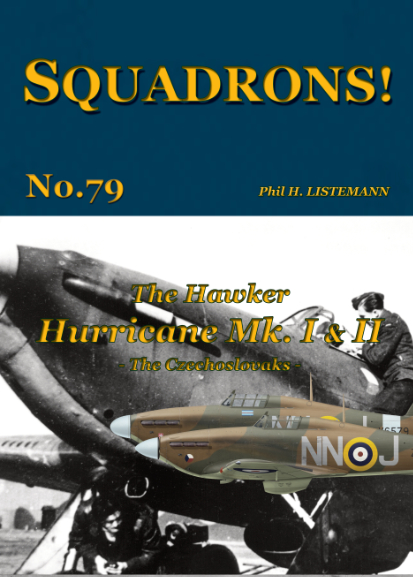
Czechoslovakia disappeared as a country in March 1939. Many pilots of the Czech Air Force decided to escape and initially joined France. Many of them fought for the French in May and June 1940 and when France collapsed, they found their way to England. They were re-trained and two fighter units were formed, Nos 310 and 312 Squadrons, respectively in July and August, seeing action during the last weeks of the Battle of Britain on Hurricanes. Both units flew on Hurricane until the end of 1941, when they relinquished the Hurricane for Spitfires.
************************
HOW TO ORDER:
Send your mailing address with your phone number in using ‘contact’ button and we will respond with a Paypal request with the following amount:
EU, UK and USA: 13.00 Euros postage included
Rest of the World: 14.50 Euros postage included
Multiple purchases with combined postage possible.
********************
PDF version is also available as 978-2-494471-45-0
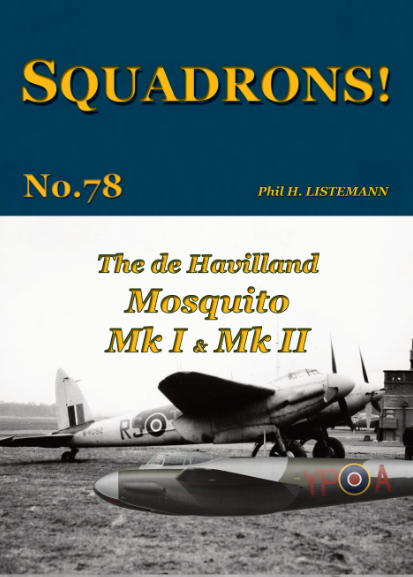
Originally conceived as an unarmed fast bomber, the Mosquito’s use evolved during the war into many roles, including low to medium-altitude daytime tactical bomber, high-altitude night bomber, pathfinder, day or night fighter, fighter-bomber, intruder, maritime strike, and photo-reconnaissance aircraft. It was also used by the British Overseas Airways Corporation as a fast transport to carry small, high-value cargo to and from neutral countries through enemy controlled airspace. The crew of two, pilot and navigator, sat side by side. A single passenger could ride in the aircraft’s converted bomb bay when necessary. Very versatile, it became one of the major aircraft types of the RAF during WW2. This book develops the operational history of Mosquito Mk I, used a photo-reconnaissance aircraft and the Mk II, originally built as a night fighter.
ISBN: 978-2494471-42-9
******************************
HOW TO ORDER:
Send your mailing address with your phone number in using ‘contact’ button and we will respond with a Paypal request with the following amount:
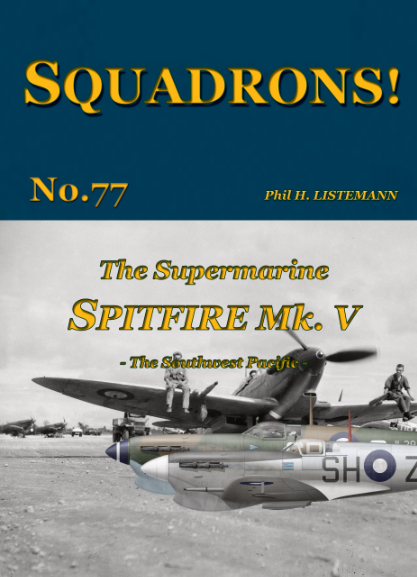
A detailed study of the operations of the Spitfire Mk. V in the Southwest Pacific. Introduced in the Southwest Pacific at the end of 1942, the Spitfire played a major role in the following months with Nos 54, 452 and 457 Squadrons part of No 1 Wing RAAF, also known as Churchill Wing, formed to defend Darwin in Northern Australia. Later on, the Spitfire was deployed with No 79 Squadron RAAF in New Guinea to fight against the Japanese. The operational usage came to an end by the end of 1944, being replaced by the Spitfire Mk VIII, even if a single fighter squadron, No 85 RAAF, based in Australia, flew the Mk V until the end of war. Over 60 photographs illustrate the book as well 13 colour profiles.
ISBN: 978-2494471-40-5
******************************
HOW TO ORDER:
Send your mailing address with your phone number in using ‘contact’ button and we will respond with a Paypal request with the following amount:
Aces & Leaders – The North American Mustang over Italy & the Balkans explores the stories of the men who flew the legendary North American Mustang and the machines they piloted over the rugged skies of Italy and the Balkans during the Second World War. With a focus on RAF and Commonwealth operations, this richly illustrated volume follows the evolution and deployment of the Mustang Mk. III and Mk. IV in the Mediterranean theatre.
46 pages, 24 profiles, book printed with high quality paper
(book available on this site only)
A SQUADRONS! spin-off series, mainly focusing with modellers’ needs
ISBN 978-2494471-38-2
sample pages (profile and photo)
PDF available below the order form with ISBN 978-2494471399.
To place an order for a paperback version of the book please to fill out the form below :
To place an order for the PDF version of the book, click the Purchase button below :